
The short answer to Web5 vs Web3 is this. Web3 means applications built on public blockchains: tokens, smart contracts and wallets, where a shared ledger replaces a company's database. Web5 was a proposal from Block, the payments company, to give people control of their own identity and data without putting everything on a blockchain, using decentralised identifiers, verifiable credentials and personal data stores called decentralised web nodes. As a search term, Web5 barely exists: in our Google Trends study on 14 November 2026 it scored zero, below the level Trends can measure. Its building blocks did not disappear, though. They are now maintained by a standards foundation, and two of them are W3C standards, which makes them the part worth building on.
Web5 scored zero in our search data
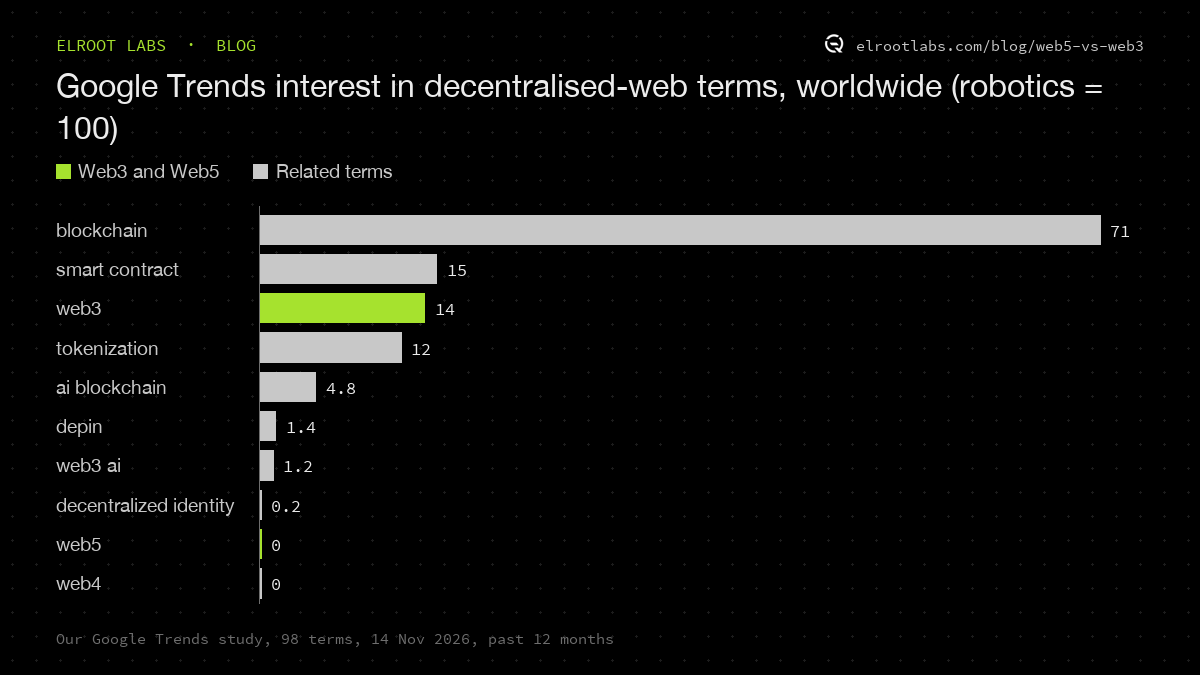
We compared 98 technology search terms on Google Trends over the past twelve months, putting "robotics" in every comparison so that all of them share one scale on which robotics scores 100. These are the decentralised-web terms from that study, worldwide:
| Search term | Interest (robotics = 100) | Last three months against the first three |
|---|---|---|
| blockchain | 71 | flat |
| smart contract | 15 | up sharply |
| web3 | 14 | flat |
| tokenization | 12 | flat |
| ai blockchain | 4.8 | down |
| depin | 1.4 | down |
| web3 ai | 1.2 | down |
| decentralized identity | 0.2 | too small to call |
| web5 | 0 | below Trends' threshold |
| web4 | 0 | below Trends' threshold |
The related queries say more than the scores. The few searches that contain "web5" are mostly for a login page, a bank and a crypto token that happen to share the name, alongside a trickle of "what is web5". Searches for "web4" are mostly typos of "whatsapp web". For "decentralized identity", the top related query is the name of the foundation that now maintains the Web5 code.
Web3 itself has not grown over the year, but one corner of it has. Searches for "web3 development" rose roughly thirteenfold worldwide, and grew even faster in India and the UAE, while "smart contract development" was the fastest-rising query for smart contracts. People looking to build are still searching. People curious about the next numbered web are not.
What Web3 and Web5 each set out to do
| Web3 | Web5 | |
|---|---|---|
| Core idea | Shared public ledgers replace central databases | People hold their identity and data; apps ask for access |
| Identity | A wallet address | A decentralised identifier (DID) the person controls |
| Where data lives | On a blockchain, or referenced from one | In the person's own data store, a decentralised web node |
| Role of a blockchain | Central | Used only where needed, for example to anchor identifiers |
| Tokens | Usually part of the design | Not required |
| Status in 2026 | Active; search interest flat over the past year | The name has faded; the components continue under a foundation |
The appeal of the Web5 framing was that it separated two things Web3 had bundled together: owning your identity and owning a token. You can want the first without the second, and many organisations do, for credentials, logins and records that should outlive any one company's database.
Web5's parts outlived the name
On 26 November 2024, Block contributed the open-source components it had built "under the Web5 umbrella" to the Decentralized Identity Foundation, a standards body (DIF announcement). The contribution covered three areas: decentralised identifiers, including a method called did:dht; verifiable credentials; and decentralised web nodes.
Two of those rest on W3C standards that do not depend on the Web5 name at all. Decentralized Identifiers v1.0 became a W3C Recommendation on 19 July 2022: an identifier you create and control yourself, resolvable to the public keys that prove you own it. The Verifiable Credentials Data Model 2.0 became a Recommendation on 15 May 2025: a format for a signed claim, such as a qualification or a licence, that the holder can present and anyone can check against the issuer's public key without contacting the issuer.
So the honest answer to "what happened to Web5?" is that the label lost and the plumbing carried on. That is a common pattern, and it is a useful one to recognise when a numbered web or a new acronym arrives with a lot of noise.
Which names to build and write for
For a company deciding where to spend effort, the search data and the standards point the same way.
- If you are building something where people must own and present their own records, design around DIDs and verifiable credentials by those names. They are what developers, auditors and procurement teams will look for, and they are standards you can cite in a contract.
- If you need several parties to write to one shared record that none of them controls, that is the case a blockchain was built for, and "web3 development" and "smart contract development" are where the demand is.
- If you need neither, a well-run database with good access control is usually the right answer, and saying so plainly is worth more to a client than a new label.
- If you are writing about it, use the names people search for. Our own study found effectively no searches for Web5, so this post leads with the comparison people do search for and spends most of its words on the standards.
There is also a lesson here about following trends. A term can be everywhere in announcements and nowhere in searches. Checking the search data first, as we did before writing this, costs an hour and stops a team from building its content, or its product name, around a word its customers do not use. The same study shaped our choice of other topics, from post-quantum cryptography to AI agents. If you are weighing a decentralised design and want a straight answer on whether you need one, ask us.