
Whether edge AI or cloud AI costs less depends almost entirely on how often each device asks the model something. With prices we checked on 14 November 2026, a device making occasional text requests is cheaper to run in the cloud: a $305 board only pays for itself above roughly 2,900 requests a day, about one every 30 seconds. A device watching a camera is the opposite case. Sending one full frame every ten seconds to a cloud model would cost a fleet of 1,000 devices about $1,293 a day in model fees alone, against about $53 a day for a $45 board on each device doing the work locally. The calculation below shows every number, so you can put your own product on the line.
The prices we used, checked on one day
Cloud prices fell and edge hardware prices rose in 2026, which is why this calculation needs dating.
On the cloud side, we used the cheapest current model from one major provider. Anthropic's pricing page lists Claude Haiku 5.5 at $0.10 per million input tokens and $0.50 per million output tokens for prompts up to 100,000 tokens. OpenAI's cheapest listed model was priced the same that day, so the choice of provider does not change the result. Images are billed as tokens, and Anthropic's vision documentation gives the counts we used: 64 tokens for a 200 by 200 pixel image and 1,296 for a one-megapixel image.
On the edge side, we used two boards that represent the two ends of what small devices run. Raspberry Pi's product page listed the Raspberry Pi 5 with 16GB of memory at $305, enough for a small language model. A Raspberry Pi news post from February 2026 announced a $45 version with 1GB, enough for a small image classifier, in a post explaining a round of price rises of $10 to $60 per board driven by memory costs. Memory is exactly what running a model locally needs most, so the price shift lands hardest on edge AI.
The assumptions, all of which you should replace with your own:
| Assumption | Value | Effect on the result |
|---|---|---|
| Device life | 3 years | Longer life favours edge |
| Average power draw | 5 W | Small either way, about one cent a day |
| Electricity | 10 US cents per kWh | Small either way |
| Hardware counted | The board only | Flatters edge: no power supply, storage, case or radio |
| Cloud costs counted | Model tokens only | Flatters cloud: no data plan or network cost |
| Text request | 500 tokens in, 100 out | Typical of a short classification or extraction |
What each request costs, and where the lines cross
At those prices, a text request of 500 tokens in and 100 out costs $0.0001, a hundredth of a cent. A one-megapixel image with a short instruction and a short answer costs about $0.00015, and a 200-pixel thumbnail about $0.000026.
On the device side, a $305 board spread over three years costs about 28 cents a day, plus about a cent of electricity: $0.29 a day. The $45 board costs about 5 cents a day all in.
Dividing one by the other gives the number of requests per device per day at which the two options cost the same:
| Workload | Cloud cost per request | Break-even on a $305 board | Break-even on a $45 board |
|---|---|---|---|
| Text request | $0.000100 | 2,905 per day, one every 30 s | not comparable: too small for a language model |
| 200 px thumbnail | $0.000026 | 11,005 per day, one every 8 s | 2,011 per day, one every 43 s |
| 1 MP image | $0.000150 | 1,942 per day, one every 44 s | 355 per day, one every 4 minutes |
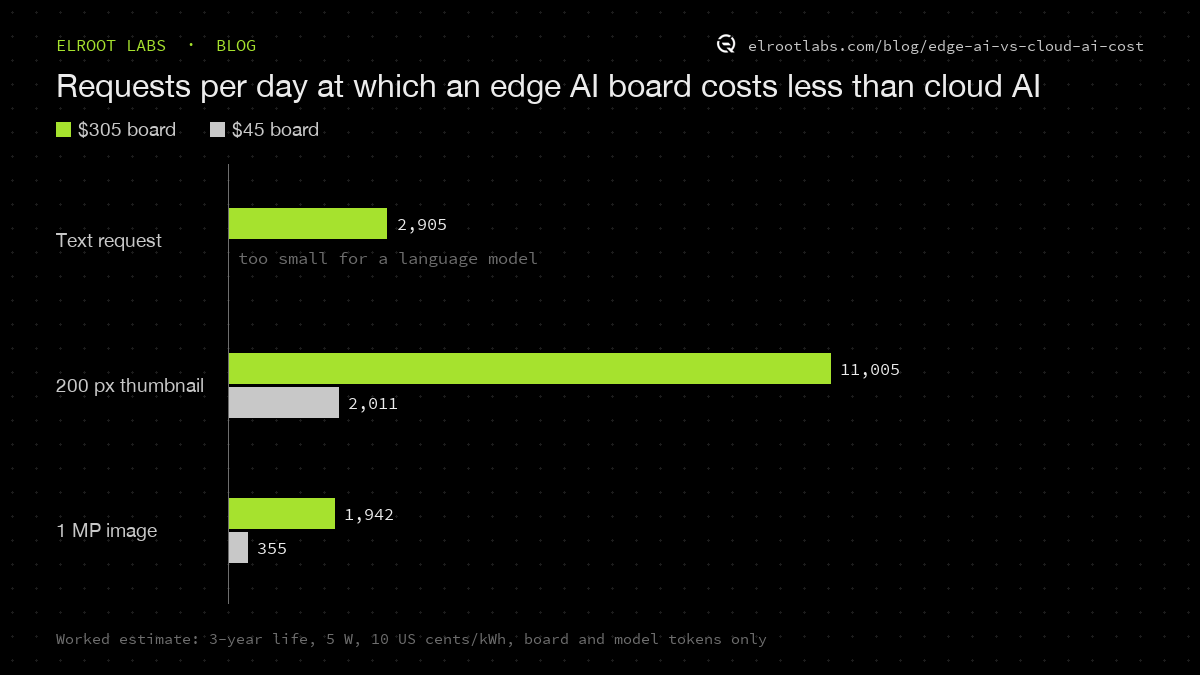
Below the break-even rate, the cloud is cheaper on direct cost. Above it, the device pays for itself.
Two fleets, two opposite answers
Take a fleet of 1,000 devices that each send 200 text requests a day, which is a lot for a kiosk or a field tablet. In the cloud that is 200,000 requests and about $20 a day at Haiku 5.5 prices. Putting a 16GB board in every device to run a model locally costs about $291 a day in hardware and power. The cloud is about fourteen times cheaper, and it runs a far larger model than a board can hold.
Now take 1,000 cameras that each send one full frame every ten seconds for an inspection or a count, 8,640 frames per device per day. In the cloud that is about $1,293 a day in model fees at the per-image token counts above, before paying to move 8.6 million images across a network. On a $45 board per camera running a small classifier, it is about $53 a day. The edge is about twenty-four times cheaper, and most of the cloud's network cost has not even been counted.
The pattern generalises. Requests that are occasional, text-sized and benefit from a large model belong in the cloud. Requests that are continuous, sensor-sized and need only a small model belong on the device. Most real products have both, and the right design usually splits the work: a small model on the device that watches everything and a large model in the cloud that sees only what the device flags.
What the cost calculation leaves out
Direct cost is often not the deciding factor, and the calculation ignores four things that frequently are.
Connectivity. A device that loses its connection cannot reach a cloud model at all. For field equipment, factories and anywhere with unreliable networks, local inference may be the only design that keeps working, whatever it costs.
Latency. A local model answers in the time it takes to run. A cloud model adds a network round trip and queueing, which matters for control loops and for anything a person waits on.
Data leaving the site. Some data should not leave the building, for legal or contractual reasons. Local inference keeps it there.
Model quality. A board with 16GB holds a small model, and a large hosted model is better at most language tasks. We measured how little memory an ordinary machine actually has free for a model in running an LLM offline, and the answer was about 3GB on a 16GB laptop during a working day.
How to run this for your own product
- Estimate requests per device per day at the busy end of normal use, not the average.
- Price your actual cloud request: count input and output tokens, or image size, on the model you would use.
- Price your actual device: board, power, storage, enclosure, radio and the extra engineering of shipping a model on hardware.
- Compute the break-even rate and see which side of it you sit on, with some margin. Prices on both sides moved by large amounts this year.
- Then weigh connectivity, latency, data location and model quality, which often settle the question before cost does.
The script and every input are in our evidence file, and changing an assumption takes one line. If you are designing a connected product and need to decide where its models run, our post on IoT prototype development in India covers the hardware path, and we are happy to work through the numbers with you.