
The clearest AI trend heading into 2027 is a change in what people ask about. Over the year to 14 November 2026, searches about what AI does for a person grew: AI agents, AI coding and AI automation all rose against a steady baseline. Searches for the machinery underneath fell: "large language model", retrieval-augmented generation and the Model Context Protocol all dropped sharply. Robots drew interest as products with prices, quantum computing lost most of its early-year spike, and India searched for agentic AI and connected devices far more than the rest of the world. This post separates what our data shows from what we infer from it, and says for each expectation what would prove it wrong.
How we measured
We ran 32 Google Trends comparisons covering 98 search terms on 14 November 2026, each over the previous twelve months. Trends only compares up to five terms at a time and scales each comparison to its own peak, so every comparison included "robotics" as a common reference. Every figure below is on that scale: robotics = 100. Most comparisons were worldwide, with smaller sets for India, the United States and the UAE.
For direction, we compared each term's first 13 weeks with its last 13 complete weeks, adjusted for how robotics moved over the same weeks, and called anything within 15 per cent either way flat. Trends measures relative search interest, not volume and not adoption, so a falling term can mean people lost interest or simply that they stopped needing to search for it. Several terms also turned out to mean something else to most searchers: "AGI" is mostly an American tax term, "6G" mostly a scooter, and "AI safety" mostly news searches. The full table, with those warnings, is in our evidence file.
Searches moved from what AI is to what it does
| Rising over the year | Score | Falling over the year | Score |
|---|---|---|---|
| ai agents | 59 | large language model | 13 |
| ai automation | 48 | retrieval augmented generation | 4.5 |
| ai coding | 34 | model context protocol | 10 |
| ai workflow automation | 3.4 | small language model | 2.0 |
| ai voice agent | 3.1 | multimodal ai | 5.0 |
| cybersecurity | 122 | open source ai | 25 |
| smart contract | 15 | ai regulation | 26 |
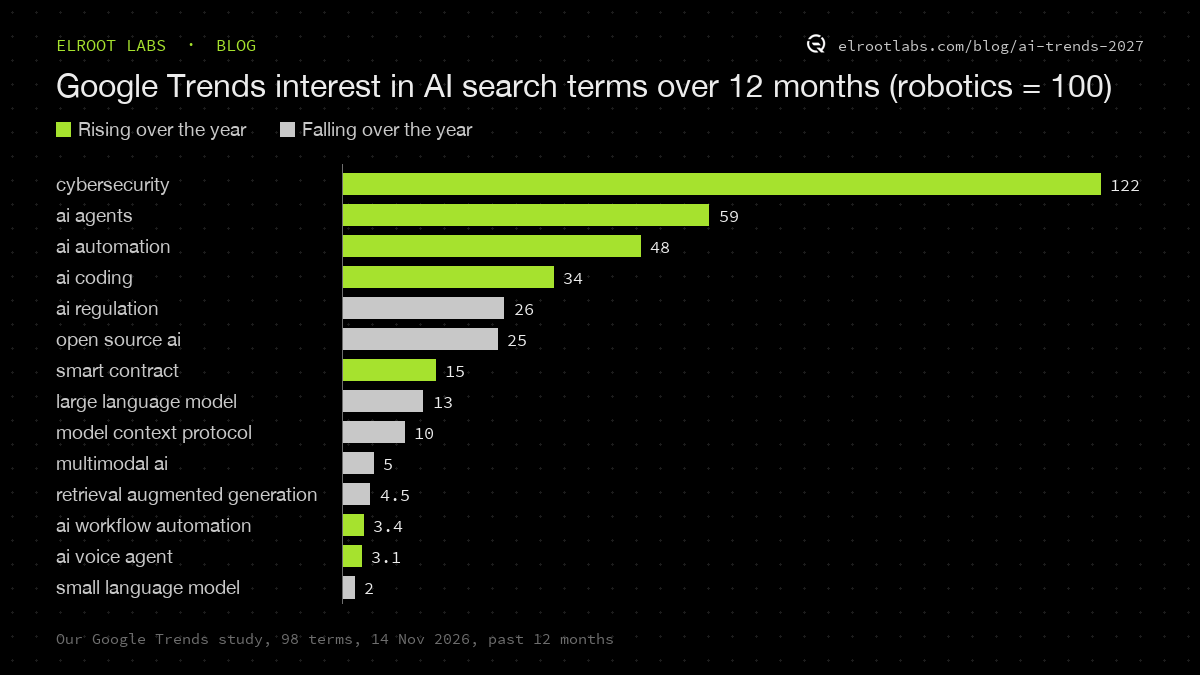
On the left, every AI term describes a job: an agent that does work, automation, writing code. On the right, most describe how the technology is built. Our reading is that the vocabulary of AI is going the way most technologies' vocabulary goes. People stop searching for the component once it is assumed, and start searching for what they can do with it. People buying broadband rarely search for the protocols underneath it.
That reading has limits. The Model Context Protocol fell by about three-quarters between the two periods, and that could mean less interest, or that developers now go straight to its documentation instead of searching the name. Either way, a team writing about AI for buyers in 2027 should expect fewer of them to arrive by searching for the plumbing.
Agents are the term to watch, and the questions are practical
"AI agents" scored 59 worldwide and rose by about a quarter over the year, while "agentic AI" held steady at 29. The related searches are the interesting part. The top ones include "best ai agents", "what is ai agents" and "free ai agents"; rising fastest are "ai coding agents" and "autonomous ai agents". In the UAE, people searched for the difference between the terms, with "ai agents vs agentic ai" and "generative ai vs agentic ai" among the fastest-rising queries there. We wrote up that comparison in agentic AI vs AI agents.
Two names rose sharply in every region we measured, and broke out in most: OpenClaw and Moltbook, the second described in searches as a social network for AI agents. Both are news-driven and may not last. What they signal is that agents acting in public, with real accounts and real consequences, became a mainstream topic this year.
What we expect in 2027: buyers' questions about agents move from "what is it" to how to run one, meaning cost, permissions, evaluation and who approves what. What would prove us wrong: "what are ai agents" and "best ai agents" staying the dominant related searches through 2027. We have already written about the operational side, including AI agent permissions mapped on our own agent.
Coding with AI is becoming its own category
"AI coding" scored 34 worldwide and rose by about a quarter; in India it scored 43 and also rose. Its related searches are product names: Claude, Codex, OpenCode (up roughly nineteenfold) and Google's Antigravity, which broke out. "Context engineering" rose to sit alongside "prompt engineering", whose own interest fell.
What we expect in 2027: competition between coding tools shifts from model quality to workflow, meaning how a tool fits review, testing and a team's repository. What would prove us wrong: searches converging on one product name the way "ChatGPT" absorbed general chatbot searches. We describe how we manage the context our own writing agent sees in context engineering, measured in words.
Robots, chips and quantum: interest as products and as stocks
Robotics was our reference point, so its score is 100 by definition, and it was flat. Inside it, "humanoid robot" scored 7.9 and was flat, but its related searches were about buying: "humanoid robot price", Unitree, Tesla Optimus and "best humanoid robot", with a stream of breakout searches about specific robots in the news. "Physical AI" scored 23 and drew searches for Nvidia's work and for Figure AI. Industrial terms were small: "industrial robot" scored 4.2 and held steady, and "cobot" scored 1.6, with "cobot automation" and "cobot vs robot" rising among its related searches.
"Semiconductor" scored 104, but its related searches were mostly about stocks. "Quantum computing" scored 49 on average and fell by four-fifths from its early-year spike to the last three months; it too was dominated by news and stock searches. "AI data center" scored 42 and held steady.
What we expect in 2027: robotics searches keep moving towards price, availability and use in factories, as the related searches already show. What would prove us wrong: "what is a humanoid robot" overtaking price and brand searches again.
India searches differently
On the same robotics-based scale, India searched for "agentic AI" at 52 against 29 worldwide, for "IoT" at 86 against 14, and for "embedded systems" at 13 against 5.4. Much of that is learning intent: "agentic ai course", "iot project" and "embedded systems course" were among the top related searches. "Generative AI" fell by more than a quarter in India over the year, and Sarvam AI broke out in searches for sovereign AI, the subject of our sovereign AI post. "India semiconductor mission 2.0" and "semicon india 2026" were the fastest-rising semiconductor searches in India.
What we expect in 2027: India's strong interest in learning agentic AI and IoT turns into demand for engineers who can ship them, and for partners who can build hardware and software together. That is our view as a company that does both, and the data supports the interest more than it proves the demand. What would prove us wrong: the course-related searches falling without any rise in searches about building or hiring.
What we would not bet on
Some terms we expected to be large were close to zero. "Web5" and "Web4" did not register at all, and "spatial computing", "neuromorphic computing" and "brain computer interface" each scored under 2. Interest in "the metaverse" rose late in the year, driven by searches asking whether it is shutting down. We looked at the Web5 case in detail in Web5 vs Web3.
If you plan products or content around 2027 trends, the cheapest research available is an afternoon with Trends and a fixed reference term. It will not tell you what to build. It will tell you which words your buyers use, which is worth knowing before you name anything.