
SEO vs AEO vs GEO comes down to what you want from a search: SEO earns the ranking, AEO earns the direct answer, and GEO earns a citation or mention inside an AI assistant's reply. Two more names complete the set: AIO, for Google's AI Overviews and AI Mode, and SXO, for what the visitor experiences after the click. At Elroot Labs we made all five a rule for every post on 18 November 2026. Here is each one defined, then applied to one real page, with what it changed and what it can be measured with.
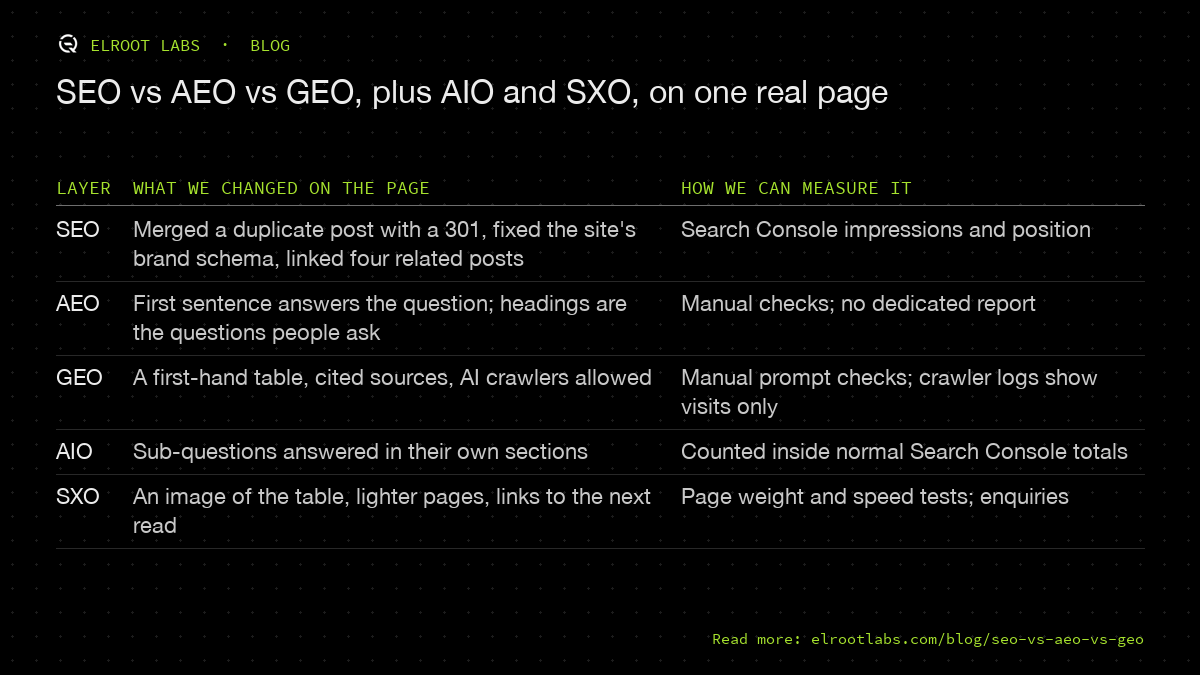
| Layer | What it targets | What we changed on the page | How we can measure it |
|---|---|---|---|
| SEO | Rankings: crawling, relevance, authority | Merged a duplicate post with a 301, fixed the site's brand schema, linked four related posts | Search Console impressions and position |
| AEO | The direct answer in snippets and answer boxes | First sentence answers the question; headings are the questions people ask | Manual checks; no dedicated report |
| GEO | Citations in ChatGPT, Perplexity, Gemini, Claude | A first-hand table, cited sources, AI crawlers allowed | Manual prompt checks; crawler logs show visits only |
| AIO | Google AI Overviews and AI Mode | Sub-questions answered in their own sections | Counted inside normal Search Console totals |
| SXO | The visit after the click | An image of the table, lighter pages, links to the next read | Page weight and speed tests; enquiries |
The five, defined
SEO (search engine optimization) is everything that helps a search engine find a page, understand it, and rank it: crawlable pages, a clear topic per page, links between related pages, structured data, and links from other sites.
AEO (answer engine optimization) shapes a page so a search engine or voice assistant can lift a direct answer from it: the answer in the first sentences, headings phrased as the questions people ask, and lists or tables where the answer is a list or a comparison.
GEO (generative engine optimization) aims at being cited or named in answers written by AI assistants. The term comes from a 2023 research paper, GEO: Generative Engine Optimization, which tested how page changes affect visibility in generated answers. In practice it rewards material the assistant cannot get elsewhere, stated plainly enough to quote.
AIO (AI optimization) is used here for Google's own AI features, AI Overviews and AI Mode. Google says there are no additional requirements to appear in them beyond normal SEO, and that both may run several related searches across subtopics to build one answer. That second point is the practical one: a page that also answers the follow-up questions gets more chances to be used.
SXO (search experience optimization) covers what happens after the click: does the page match what the searcher wanted, does it load fast on a phone, and is the next step obvious.
They overlap on purpose. A page that does SEO well is most of the way to AIO, and the plain, specific writing AEO asks for is what GEO needs too. Treating them as five checks, rather than five jobs, is what made them useful for us.
The page: our AI agent safeguards guide
The page is our guide to the safeguards an AI agent needs in production. It went live on 31 October as a 3,960-word article titled "What Does a Production AI Agent Need Before It Is Safe to Use in a Business?". Its first sentence was "AI agents can do more than generate text." Its headings were numbered labels, from "1. Define What the AI Agent Is Allowed to Do" to "10. Use a Production-Readiness Checklist", followed by a FAQ, a conclusion and references. An older post from September covered the same ground.
We rewrote it on 17 November. Here is what each layer asked for, and what changed.
SEO: one page per question, and a name Google can trust
Two pages answering the same question split the signals between them, so the September post was merged in and now redirects to this one with a 301. The guide became the hub for our agent-safety posts, and on 18 November it gained links to four newer posts on permissions, logging, tool failures and production changes.
The biggest SEO fix was not on the page at all. Our site move on 16 November had dropped the other names our company goes by from the site's structured data, and Google was rewriting searches for our brand to a different company. Restoring those names on 17 November applies to every page, this one included.
AEO: answer first, and let the headings ask the questions
The rewrite opens with the answer: "An AI agent in production needs eight safeguards", followed by the eight, in one sentence. The numbered labels became the questions the page was already being found for in Google, such as "How can companies run AI agents safely in production?" and "Which actions should always need human approval?", each answered in its first lines. The article also got shorter, from 3,960 words to 2,250.
GEO: say something only we can say, and let the crawlers in
An assistant has no reason to cite a page that repeats what fifty others say. The rewrite added a table of how each of the eight safeguards runs on our own publishing agent, including the gaps we have not closed, and kept citations to OWASP, NIST and the UK's National Cyber Security Centre for the claims that need them.
None of that matters if the assistants cannot read the page. On 17 November we checked: our robots.txt has a single group that allows every crawler except on the admin area, the user agents of the main AI crawlers all received a blog page when we requested it as them, and Cloudflare's crawler report showed nothing blocked, with GPTBot alone making 408 requests that week. Visits are not citations, though, and no tool we have shows citations directly.
AIO: answer the follow-up questions too
Because Google's AI features fan out into related searches, the rewrite answers the questions around the main one in their own sections: how to roll safeguards out in order, what a business needs before an agent is safe, which runtime controls matter, and which internal sign-offs to collect. Each section works on its own, so any of them can be the piece an AI Overview uses. Google counts traffic from these features inside the normal Search Console totals, so there is no separate number to watch.
SXO: the visit after the click
On 18 November the page gained an image of its safeguards table, so a visitor scanning on a phone sees the answer before reading. The same day, a fix to our site removed about 1.5 MB of unused JavaScript from every blog post; on a throttled phone test afterwards, a post weighed 828 KB. The page now links to the four related posts, so a reader with a narrower question has somewhere to go next.
What each layer can and cannot prove
SEO is the easiest to measure, through Search Console's impressions and positions, though the numbers move slowly. SXO is next: page weight and speed are lab tests you can rerun at will, and enquiries tell you whether the page led anywhere. AEO, GEO and AIO are the hard ones. There is no report of how often an assistant cites you, so the honest method is a fixed set of questions, asked several times in each assistant on a schedule, with the results logged.
That is the plan we now write for every post before drafting it: a line for each of the five layers, saying what the post will do and how we will know. For the ChatGPT side in detail, see how to get mentioned in ChatGPT and Google AI answers, and for Google's AI Mode, what to check on your website. If you want a page or a site taken through all five, tell us what it is.