
For a task done at one station, such as loading a machine, packing or moving parts between two points, a collaborative robot arm costs less, carries more and runs longer than a humanoid robot today. Using the makers' own published figures, a cobot arm with a 5 kg payload lists at $9,500, while the cheapest humanoid we looked at starts at $13,500 for a version whose spec sheet lists an arm load of about 2 kg, a battery of about 2 hours and no programming support. Over three years of two shifts, that works out to about $1.32 per working hour for the cobot against at least $1.88 for the humanoid, once integration is counted. Against Indian labour costs, the cobot's payback runs from under two years to seven, depending on wages and on how much work it really takes off people's hands. The humanoid's case rests on tasks a fixed arm cannot reach, not on cost.
Why we ran this comparison
Interest in humanoid robots is mostly about buying them. In the Google Trends study we ran on 14 November 2026, "humanoid robot price" was among the top related searches for humanoid robots, along with brand names, and searches for cobots were small but rising, with "cobot vs robot" among the related queries that grew. People are pricing these machines. So we priced them, from sources anyone can check.
We picked one product from each category at the affordable end of the market, where a small manufacturer would actually shop. The humanoid is Unitree's G1, one of the most searched humanoid brands in our data. The cobot is UFactory's xArm 6, a six-axis arm sold with a public price. Neither choice is a recommendation, and we have not tested either machine.
What the spec sheets say
| Unitree G1 (base) | UFactory xArm 6 | |
|---|---|---|
| Listed price | From $13,500, excluding tax and shipping | $9,500 |
| Load it can handle | About 2 kg per arm | 5 kg |
| Runs on | Battery, about 2 hours | Mains power |
| Hands | None listed on the base model | Takes standard grippers |
| Programming for your own task | Not listed on the base model | Yes |
| Warranty | 8 months | Not compared here |
The Unitree figures come from the G1 product page, which lists the base model alongside an EDU version. The base model's column for secondary development, meaning programming the robot for your own application, is blank, and so is its hand specification. The EDU version has both, carries about 3 kg per arm and has an 18-month warranty, and its price is "contact sales". So the $13,500 headline buys a robot that, on the maker's own sheet, cannot be set up for a custom factory task. The model that can is priced on request.
The xArm figures come from UFactory's US store. UFactory's main site lists the xArm family from $5,299 for smaller configurations, so cheaper arms exist for lighter work.
Cost per working hour
A robot's price means little until it is spread over the hours it works. These are our assumptions, and you should replace them with yours:
| Assumption | Value |
|---|---|
| Working pattern | Two 8-hour shifts, 300 days a year |
| Depreciation | 3 years, so 14,400 working hours |
| Integration | Gripper, fixtures, guarding and programming cost as much again as the robot |
| Exchange rate | 88 rupees per US dollar |
With integration, the cobot system comes to $19,000 and the humanoid to at least $27,000. Spread over 14,400 hours, that is about $1.32 an hour for the cobot and $1.88 an hour for the humanoid, and the humanoid figure is a floor, because the model that can be programmed costs more than the one we priced.
Two practical costs sit outside those numbers. The humanoid's battery lasts about 2 hours, so a 16-hour working day needs eight swaps or charges, which means spare batteries and someone, or something, to change them. And a robot that walks needs space to walk safely among people, where an arm bolted to a bench needs a guarded area of known size.
What the payback looks like at Indian labour costs
Payback is where cobots usually make their case, so we worked it out for the cobot only. At 88 rupees to the dollar, the $19,000 system is about ₹16.7 lakh, at the xArm's listed price plus our integration assumption.
The result depends on two things: what a worker costs per month, and how much of their time the robot really saves. A robot rarely removes a job outright. Someone still loads parts, clears jams and checks quality, so we show both a full saving of two workers' time and a half saving. The monthly costs below are illustrations, not market data.
| Monthly cost per worker | Robot saves all of two workers' time | Robot saves half |
|---|---|---|
| ₹20,000 | 42 months | 84 months |
| ₹30,000 | 28 months | 56 months |
| ₹40,000 | 21 months | 42 months |
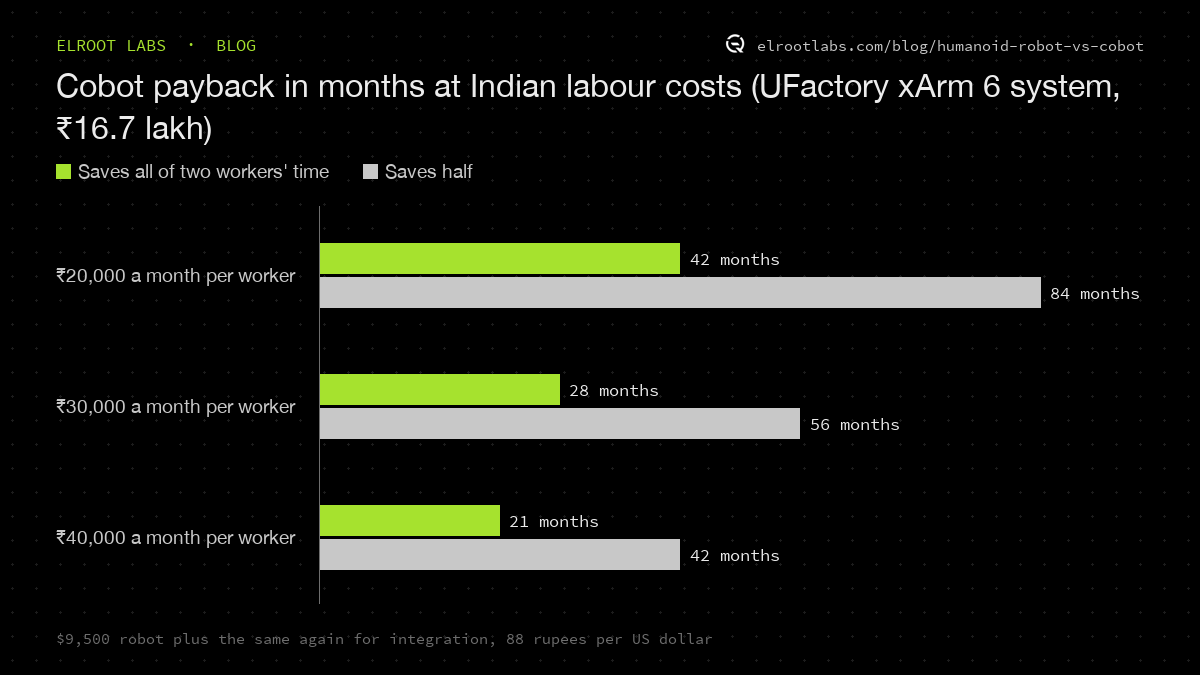
On cost alone, payback runs from under two years to seven. The robot's price is set in dollars and is much the same wherever it is installed, while the labour it saves costs less in India than in most higher-wage countries, so a payback built on wages alone takes longer here.
So in Indian factories the strongest cases for a cobot are usually not about wages. They are about work people should not do for eight hours, such as repetitive lifting, hot or sharp parts, or a third shift that nobody wants; about consistency, when the same motion done the same way removes a quality problem; and about hiring, when a station stays empty because the right person cannot be found. Each of those has a value you can estimate, and adding even part of it to the table above shortens the payback considerably.
When a humanoid makes sense
None of this means humanoids have no place. Their argument is for spaces built for people: stairs, doors, shelves at human height, tools with human handles, and tasks that change through the day. A fixed arm cannot follow work around a building. Where a job needs mobility and two hands in an environment that cannot be rebuilt around a robot, a humanoid may be the only machine that fits.
That is also why the decision belongs with the task, not the technology. Walk the job first: list each motion, weight, reach and location, and how often the task changes. If it happens at one place with parts under a few kilograms, start with an arm. If it moves around a building designed for people, price the programmable humanoid properly, with its battery logistics and a pilot to measure what it actually achieves.
How to run this for your own line
- Write down the task: weights, reaches, cycle time, locations and how often it changes.
- Get the price of the model that can actually be programmed for it, not the headline price.
- Count integration honestly: grippers, fixtures, guarding, programming, and someone's time to keep it running.
- Spread the total over your real working hours.
- Estimate how much of each worker's time the robot saves, then add a value for the work that is unsafe, unpopular or hard to staff.
The calculation script and every input are in our evidence file. We also wrote about where computer vision quality inspection pays in manufacturing, which is often the first step before a robot. If you are weighing a cobot or a humanoid for a real line, we can help you work through it.